Biology research
-
A.S. Biology, North Hennepin Community College, Brooklyn Park, MN. My first research.
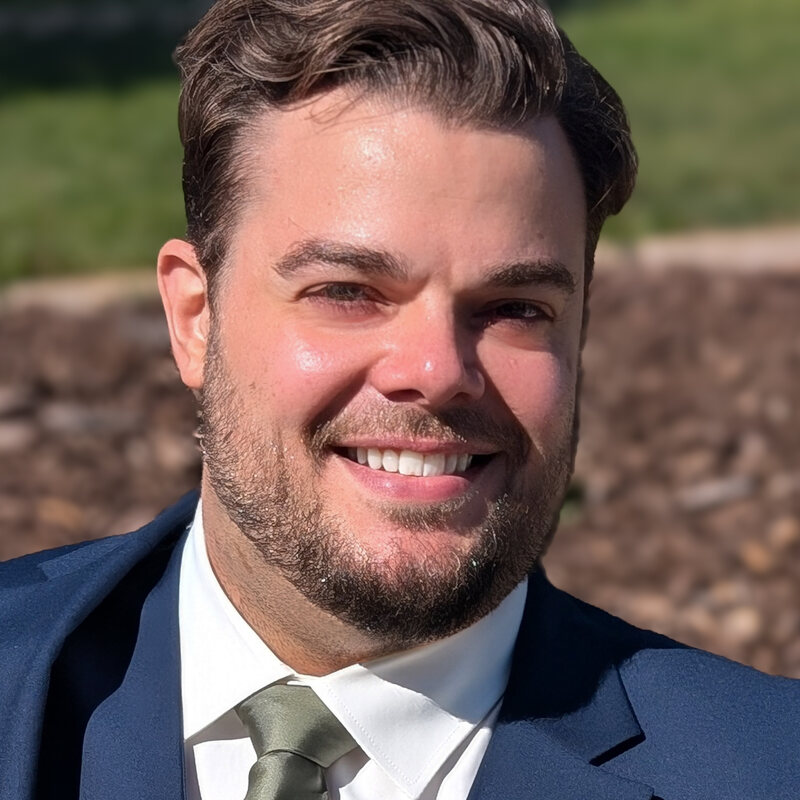
- Traced the heredity of the vestigial-wings mutation in Drosophila melanogaster through generational crosses.
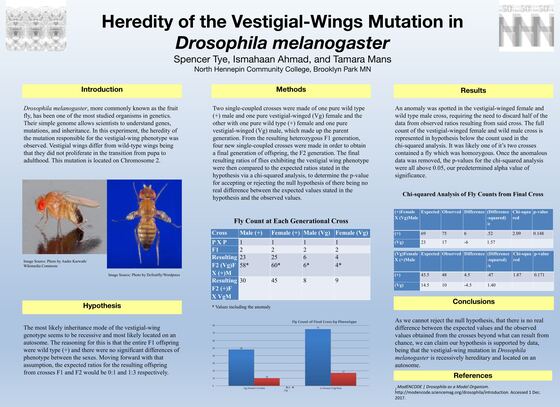
- Collected goldenrod galls to measure how gall size relates to predation by birds.
- Screened five local gall-fly populations for the bacterial endosymbiont Wolbachia with PCR and sequencing.
- Co-author of all three research posters.
Posters (PDF)
- Vestigial-wings heredity (Google Drive)
- Gall-fly predation (Google Drive)
- Wolbachia in gall flies (Google Drive)
Heredity of the Vestigial-Wings Mutation in Drosophila melanogaster. Spencer Tye, Ismahaan Ahmad and Tamara Mans. 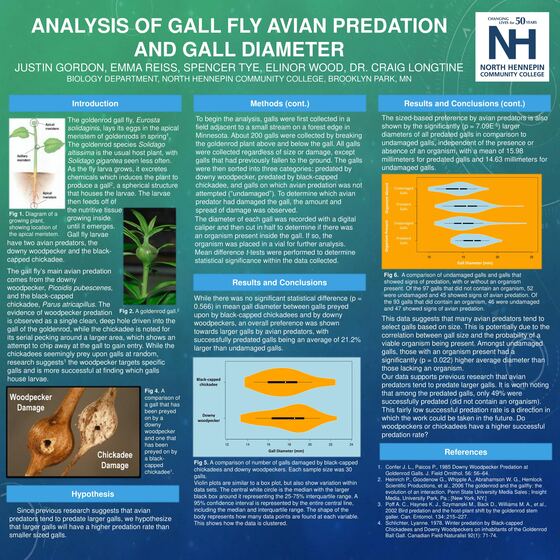
Analysis of Gall Fly Avian Predation and Gall Diameter. Justin Gordon, Emma Reiss, Spencer Tye, Elinor Wood, Dr. Craig Longtine. 
Analysis of 5 Strains of Wolbachia from Local Populations of Gall Flies. Same team. -
Sample Processing Technician, BioLife Plasma Services, Maple Grove, MN (June 2017 – January 2018)
- Processed plasma donations for storage and shipment, and collected blood samples for testing.
- Aseptic technique with biohazards, and quality-control checks under standard operating procedures.
-
Undergraduate researcher, Bemidji State University (January 2018 – May 2019). B.S. Biology (GPA 3.47).
- Studied how temperature and nutrition regulate chromatin assembly and epigenetic silencing in Drosophila melanogaster, read out with P-element reporter constructs and temperature-sensitive eye variegation, with dietary interventions such as rapamycin.
- Focused on the role of the TOR pathway in chromatin regulation and assembly.
- Our Bemidji team presented this work at the 60th Annual Drosophila Research Conference (2019), poster 417.
- At the same conference, gave a separate oral talk with the team on a science-communication project with theatre students.
- Wrote a literature synthesis on the etiological relationship between autism and ADHD, reading across genetics, neuroscience and clinical research to ask whether the two conditions share causes.
- John L. Tymoczko Scholarship for Achievement and Promise in Biological Inquiry ($2K); Dr. Richard Beitzel Biochemistry Student Research Fund Award ($500).
Posters (PDF)
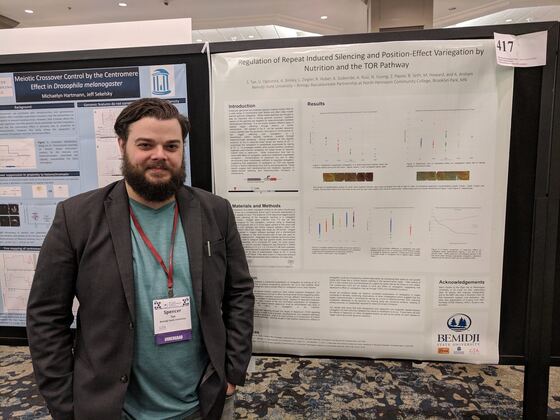
With the poster “Regulation of Repeat Induced Silencing and Position-Effect Variegation by Nutrition and the TOR Pathway,” at the 60th Annual Drosophila Research Conference, 2019. 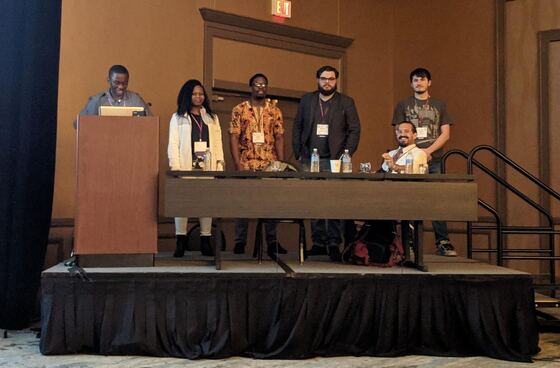
The oral talk on science communication with theatre students, 2019. 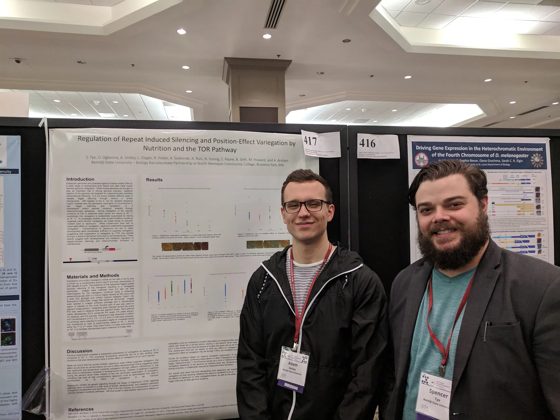
Presenting our Bemidji State chromatin work at the 60th Annual Drosophila Research Conference, 2019. 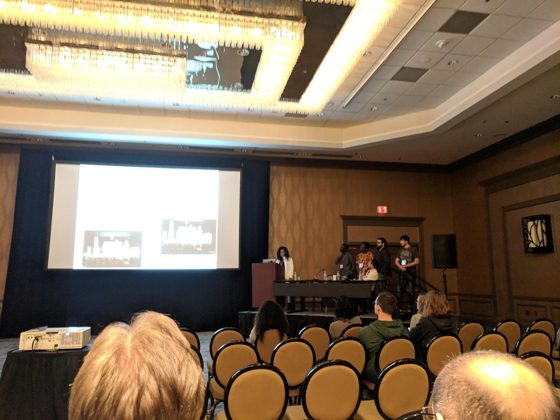
The science-communication talk, seen from the audience. 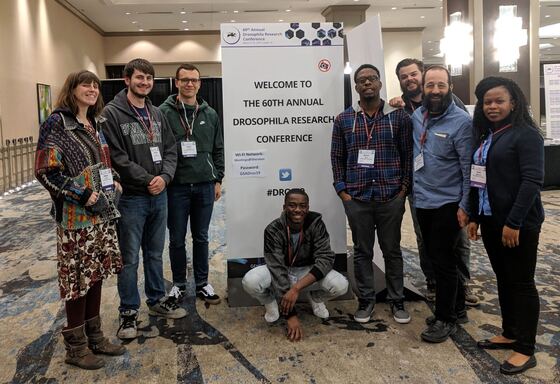
The Bemidji State team at the 60th Annual Drosophila Research Conference, 2019. 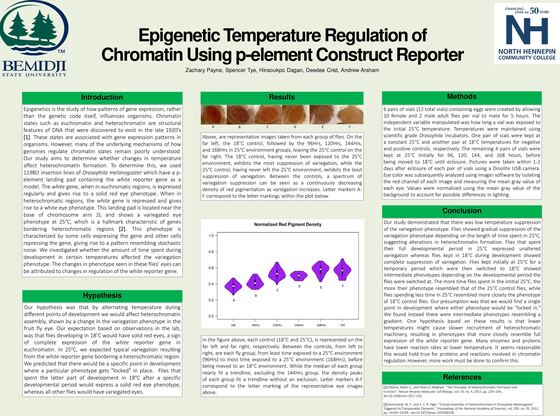
Epigenetic Temperature Regulation of Chromatin Using p-element Construct Reporter. Zachary Payne, Spencer Tye, Hinsoukpo Dagan, Deedee Crist, Andrew Arsham. 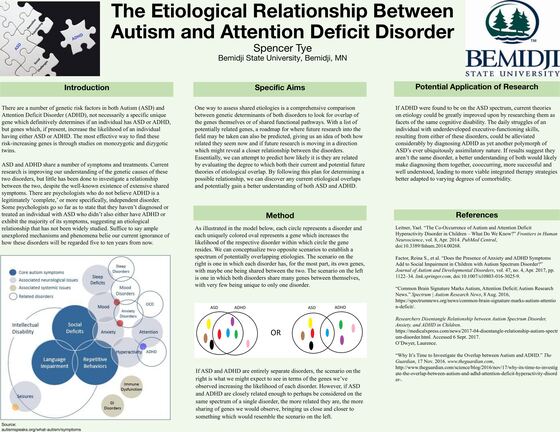
The Etiological Relationship Between Autism and Attention Deficit Disorder. Spencer Tye, Bemidji State University. 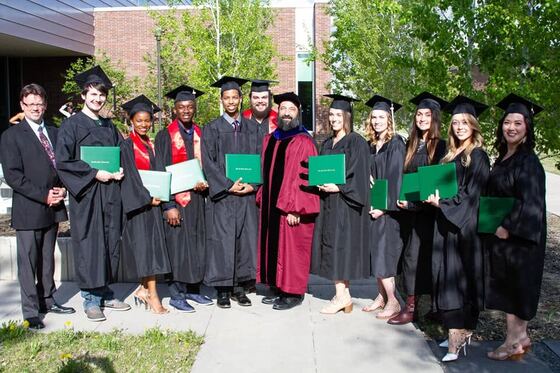
My Bemidji State graduating class in the biology program. -
R&D Technician II, Boston Scientific, Arden Hills, MN (May–July 2019)
- Decontamination and complaint investigation of explanted medical devices.
-
NIH-PREP Scholar, Ward Lab, University of Kansas, Lawrence, KS (July 2019 – May 2020)
- Studied what controls tissue-specific allometric growth, using the larval Drosophila trachea as a model and genes such as uif, Mmp1 and Gprk2 as entry points into insulin signaling.
- NIH Post-baccalaureate Research Education Program award ($27K).
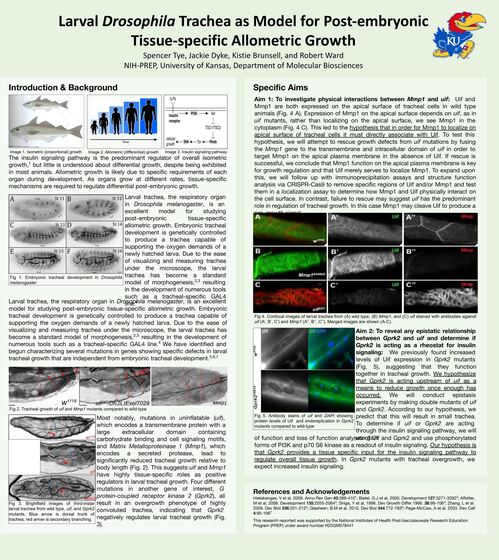
Larval Drosophila Trachea as Model for Post-embryonic Tissue-specific Allometric Growth. Spencer Tye, Jackie Dyke, Kistie Brunsell and Robert Ward. 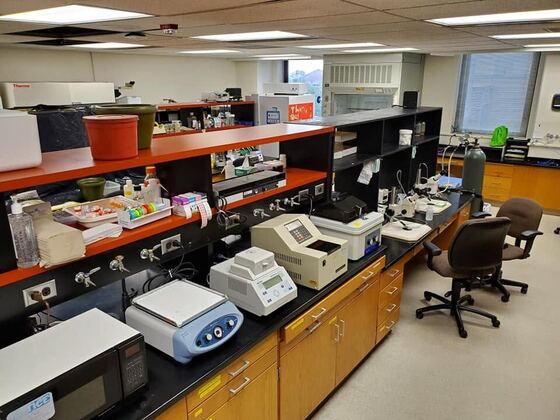
The KU fly lab during my post-baccalaureate year. -
M.S. Genetics, University of Wisconsin–Madison (GPA 3.65). NSF Graduate Research Fellow.
- Cultured primary mouse mesenchymal stem cells extracted from zeugopod bone (the forearm and shin), and used real-time imaging, including confocal microscopy, to find and characterize downstream targets of Hox genes in development and wound regeneration.
- NSF Graduate Research Fellowship ($138K), one of 13 awarded in Developmental Biology that year.
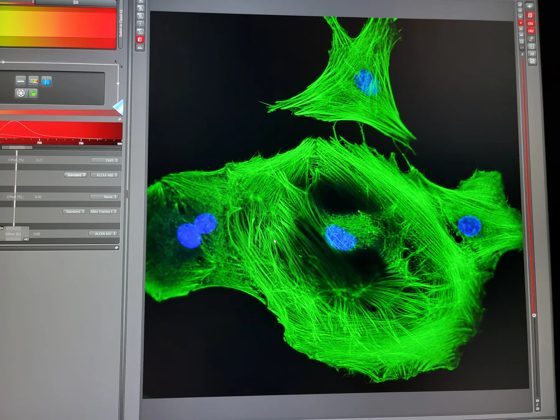
Mouse mesenchymal stem cells, cytoskeleton in green, nuclei in blue. 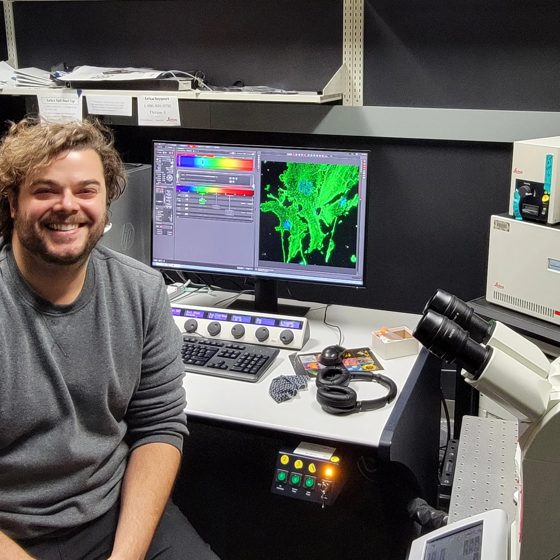
At the confocal microscope during my master’s research. -
Doctoral Researcher, Rhoads Lab. PhD Nutrition & Metabolism, UW–Madison (GPA 3.82).
- My first-author study asks how different molecular layers coordinate when mouse brains respond to caloric restriction (CR), at 10, 20 and 30 months of age.
- Findings: the transcriptional response to CR is stable across adulthood, but alternative splicing changes are dynamic and largely unique to each age. CR shifts the cortex’s lipids toward more highly unsaturated species at every age, and integration links specific lipid classes to transcripts and to categories of splicing events.
- I built and ran the full analysis: RNA-seq quantification, differential expression, co-expression networks (WGCNA), splicing detection, lipid-pathway analysis and multi-omic integration, scaled onto distributed computing. My PI suggested analyses to explore; I built them and decided what stayed.
- 24,144 genes tracked and 549 lipids quantified. Core R packages: Rsubread, limma, edgeR, mixOmics, SpliceWiz, missRanger.
- Presented as a poster at the American Aging Association (AGE) meeting in 2024, and as a poster and talk at the 6th Annual Midwest Aging Consortium symposium at Mayo Clinic in 2025.
- Henry Steenbock Academic Award ($2.5K).
- Preprint: Caloric restriction drives age-dependent and integrated remodeling of RNA processing and lipid composition in mouse brain, bioRxiv 2026.
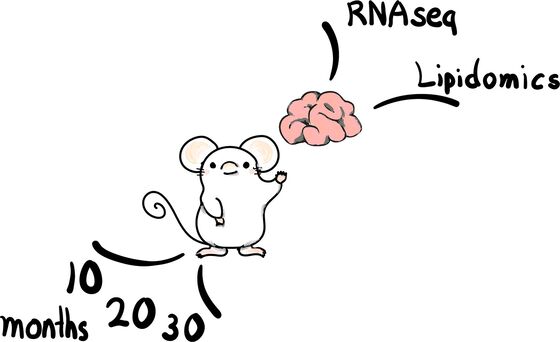
The study design, drawn by hand: mouse brain at 10, 20 and 30 months, RNA-seq and lipidomics. 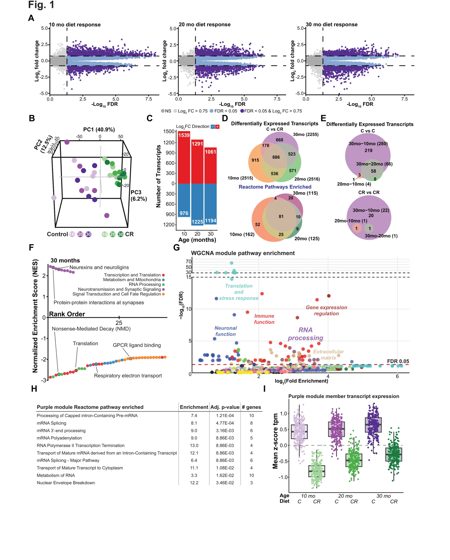
Preprint Fig. 1: A stable, age-consistent transcriptional response to caloric restriction. 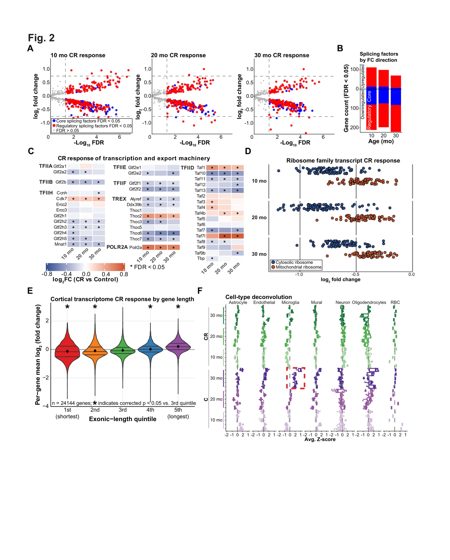
Preprint Fig. 2: Caloric restriction remodels RNA-processing machinery. 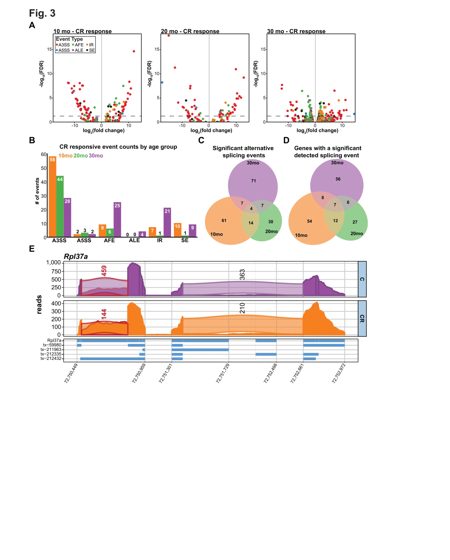
Preprint Fig. 3: Alternative splicing responses are dynamic and age-specific. 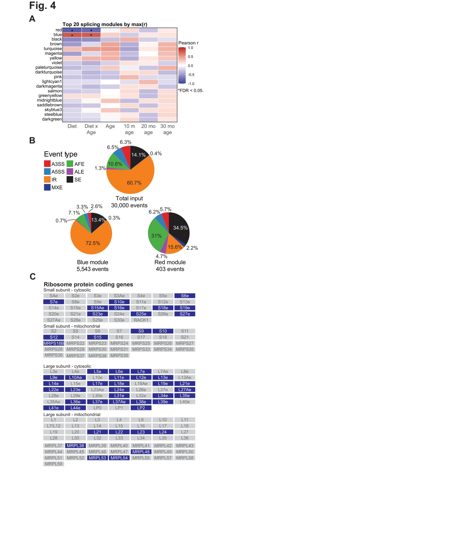
Preprint Fig. 4: Integrating splicing with the transcriptome. 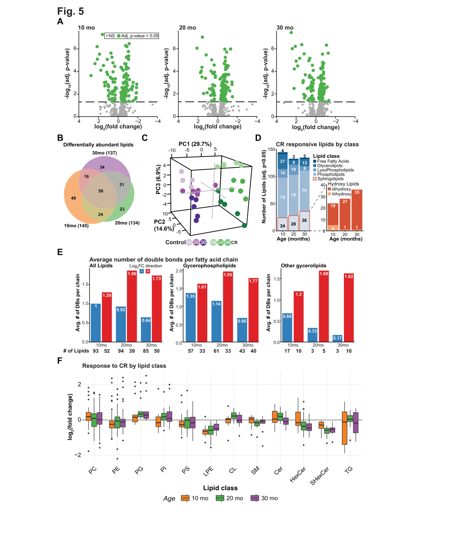
Preprint Fig. 5: Caloric restriction shifts brain lipid composition, favoring unsaturation. 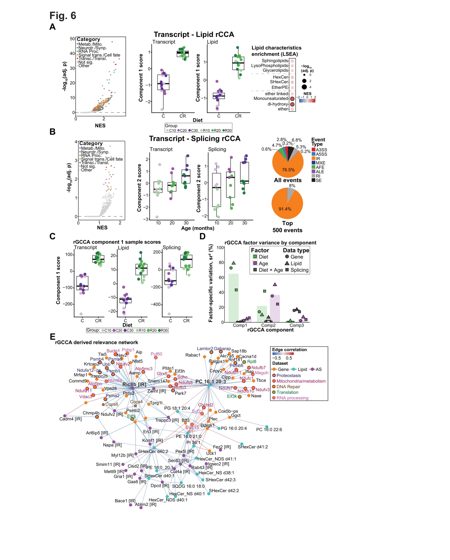
Preprint Fig. 6: Multi-omic integration links lipid classes to transcripts and splicing events. 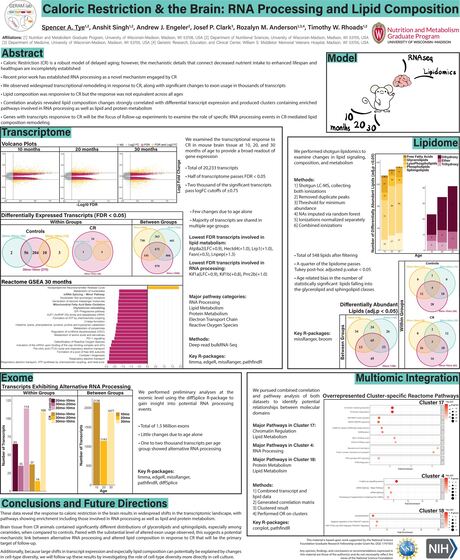
Caloric Restriction & the Brain: RNA Processing and Lipid Composition. Poster at the American Aging Association (AGE) meeting, 2024. 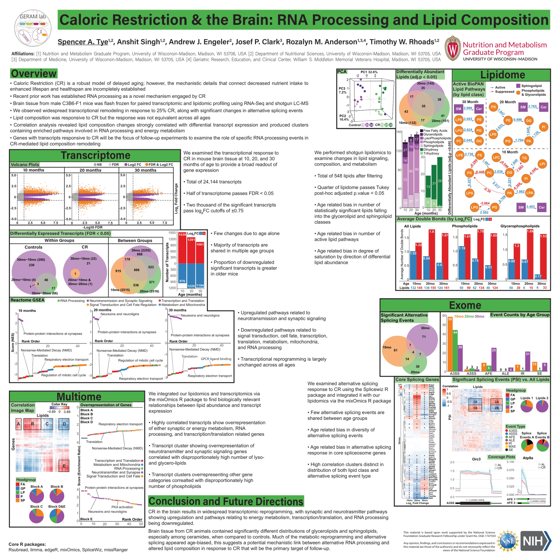
The same study as a 2025 Midwest Aging Consortium poster. 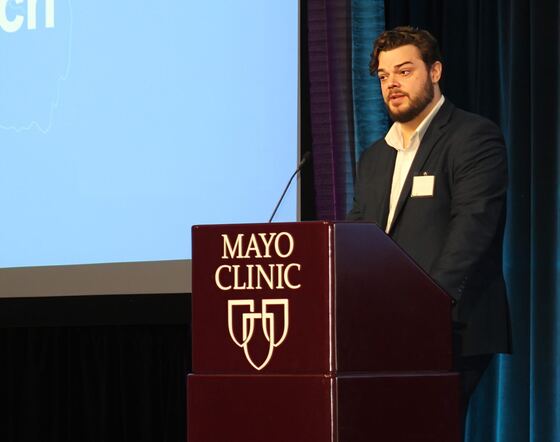
Giving my talk at the Sixth Annual Symposium of the Midwest Aging Consortium, hosted at Mayo Clinic.
Computation & data
-
Genomics Education Partnership, Bemidji State University (2018)
- Through the Genomics Education Partnership, a national consortium that annotates Drosophila genomes, took on a contig of the Drosophila eugracilis genome with six genes: Ddx1, Srpk79D, IleRS, Hem, Csp and CG11523.
- Built each gene model by hand from BLAST alignments to D. melanogaster proteins, RNA-seq tracks and competing gene predictors: every exon and splice site, each isoform, and synteny checks. Each model passed the GEP Gene Model Checker.
- The contig sits on the fly’s small “dot” chromosome. The GEP pooled annotations like mine into a study of how that chromosome evolved, with me among its authors: Recombination suppression drives expansion of the Drosophila dot chromosome, Molecular Biology and Evolution (2025).
Documents
- My GEP annotation report (Google Drive)
- BSU BIOL 4449 Genomics Lab digital notebook, 2017–2018 (Google Drive)
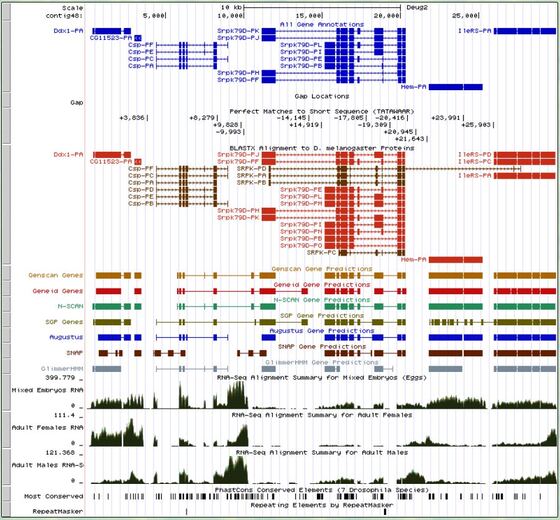
Genome-browser view of my annotated D. eugracilis region: gene models, BLAST alignments, RNA-seq and conservation tracks. 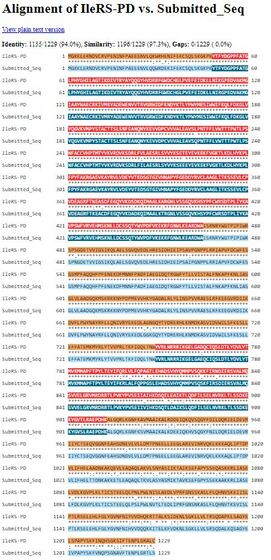
Checking my IleRS gene model against the D. melanogaster protein, residue by residue. 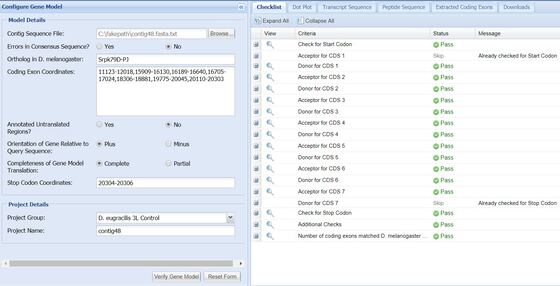
A gene model passing every check in the GEP Gene Model Checker. -
The computational side of my dissertation
- Built RNA-seq, alternative splicing, lipidomics and metabolomics pipelines, from raw reads to multi-omic integration, and scaled them onto UW’s high-throughput computing cluster (CHTC) when they outgrew a laptop.
- Unsupervised machine learning (mixOmics, rCCA, UMAP) to find the structure that different molecular layers share.
- R / Bioconductor: Rsubread, limma, edgeR, mixOmics, SpliceWiz, missRanger, WGCNA.
- Languages: R, Python, SQL, JavaScript/TypeScript, PowerShell, Bash. Tools: Git/GitHub, GitHub Actions, Docker.
- I came into graduate school as an experimental biologist and learned these computational methods for this work.
Chapter 2: splicing across public data
- My first study found that caloric restriction reshapes RNA splicing in the brain. The next question was whether those changes alter the proteins that get made.
- Screened 1,066 public mouse liver RNA-seq samples across 25 datasets, assembled from a published aging-transcriptome catalog plus my own searches, with metadata pulled by script from GEO and ENA.
- Cross-checked each sample’s diet, age and tissue against three sources, and excluded low-depth samples by a written rule.
- Re-downloaded, checksum-verified and realigned the raw reads against a current genome build on UW’s high-throughput computing cluster: 199 liver samples from 10 studies.
- Differential splicing across seven event types, caloric restriction versus ad libitum.
- Traced each splicing change forward to its transcripts, reading frame, protein domains and predicted interaction partners, using SpliceImpactR for the protein-level predictions. In liver, CR was linked to ~4,300 splicing events in ~3,100 genes; 310 transcript pairs change a protein domain, and ~100 events are predicted to rewire protein interactions. 183 automated cross-checks passed.
- A smaller muscle set (19 samples from 3 studies) returned 14 events.
- Supervised machine learning (Python, scikit-learn): built and compared models that predict an animal’s diet from its splicing and gene-expression data, and tested each one on whole studies it never saw in training.
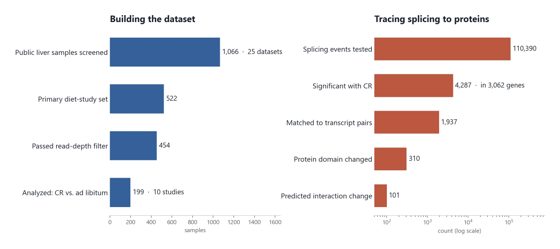
Building the dataset from public studies, then tracing CR-linked splicing changes toward their predicted protein consequences. 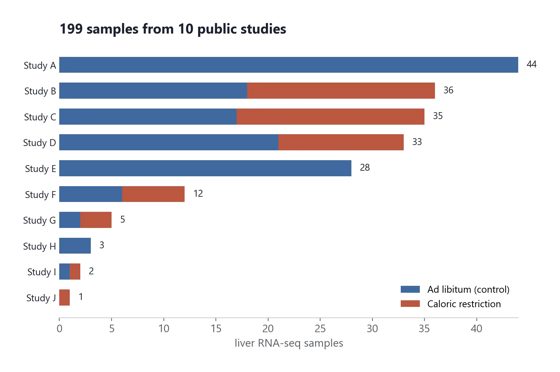
The 199 liver samples by source study, caloric restriction and ad libitum. Some studies contribute controls only. -
Computational Collaborator with labs at the Mayo Clinic, UW–Madison, the University of Michigan and Virginia Tech
Drake Lab, Virginia Tech: published in Molecular Metabolism (2026)
- The lab studied mice in which one regulatory site on Ulk1 (S555), a kinase that helps control autophagy, cannot be phosphorylated, on normal feeding and on caloric restriction, in liver and muscle.
- I connected gene expression to metabolites with regularized canonical correlation analysis (rCCA), then built correlation networks around amino acids such as alanine and serine, clustered correlation maps, gene-set enrichment inputs, and focused views of lipid and circadian genes.
- Repaired gene identifiers that spreadsheet software had corrupted in the source files.
- O.S. Willoughby, … Spencer A. Tye, … J.C. Drake. Ulk1(S555) inhibition alters nutrient stress response by prioritizing amino acid metabolism. Molecular Metabolism (2026).
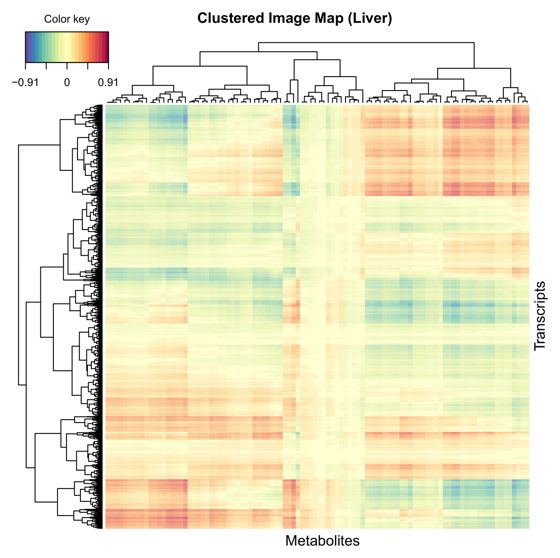
Clustered correlation map of liver transcripts and metabolites (rCCA). 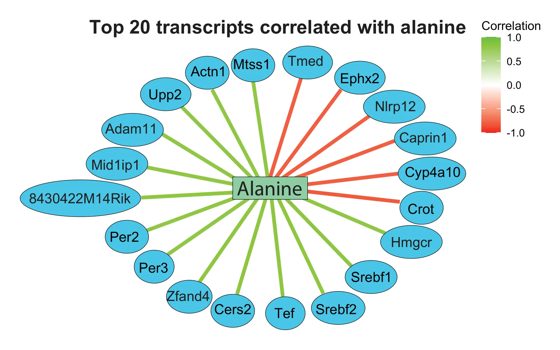
The 20 liver transcripts most correlated with alanine (green: positive, red: negative). Other collaborations
- I have run the analyses for 7 omics studies: 2 of my own and 5 for collaborating labs at the Mayo Clinic (Rochester), UW–Madison, the University of Michigan and Virginia Tech, some of them separate projects with the same lab.
- 1 is published (the Ulk1 study), 1 is my own preprint, and the rest are in preparation. Several were with the Lamming lab at UW–Madison.
-
Google Data Analytics Professional Certificate, completed January 26, 2026
- Nine courses covering spreadsheets, SQL, Tableau and R, from asking questions of data through cleaning, analysis and visualization, plus a capstone case study.
-
Volunteer Analyst, Digital Ground Game (nonprofit), since August 2026
- The nonprofit holds a ~40 TB corpus: the full historical record of Reddit posts and comments. I work with its developers and research team, adapting the methods I use to integrate high-dimensional biological data to text, to track how narratives and disinformation move between communities.
- Built and validated the pipeline on one month of one large community (July 2026: 902,144 posts and comments): topic models in R, a clean event table where every row records its source, message embeddings on a single home GPU, and UMAP/HDBSCAN structure discovery with stability checks.
- Started with topic models in R (10 to 100 topics) before moving to embeddings.
- Named the 15 largest topic clusters from their keywords and mapped them.
- Next: describe and check each cluster, then each narrative’s share over time, who takes part and how it moves through threads, the outside sources it leans on, tests for coordinated activity, and scaling toward the full corpus.
- Each output file records the data it came from, and a run stops when an input check fails.
- I share the results and methods in an annotated repository the nonprofit’s developers can build from.
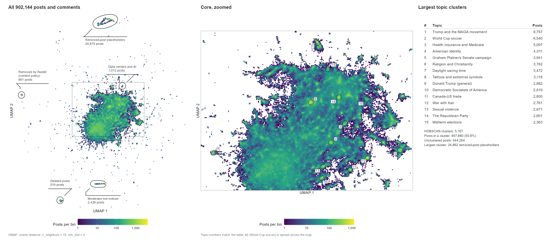
All 902,144 posts and comments on a UMAP map, with the 15 largest topic clusters. 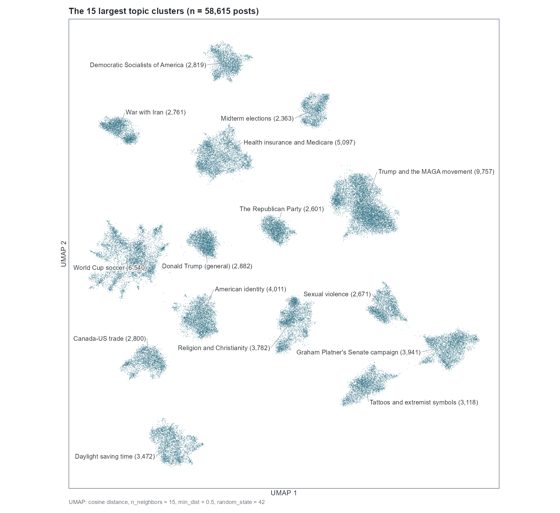
The 15 largest topic clusters (58,615 posts), mapped on their own.
AI
-
Expert Contributor, Snorkel AI (October 2024 – February 2025) and Handshake AI (2025–2026), remote
- Wrote hard biology questions for training language models. Each one had to need PhD-level knowledge to answer and be tricky or confusing for a model.
- Wrote a reference answer and a grading rubric for each question, and graded model responses against the rubrics. The work went into training data to improve the accuracy of models’ answers in scientific contexts.
- At Handshake AI, a large multimodal part: I made the test images that models had to interpret.
- Across Snorkel AI, Handshake AI and other clients: 60+ PhD-level biology questions and prompts, each with a reference answer and rubric.
- Additional paid AI post-training work under NDA.
-
- Locally hosted models, custom AI harnesses, agent orchestration, automated research and analysis workflows, and task routing across computers I built.
- A voice assistant that runs entirely on my own PC (March–April 2026, paused as a working prototype): speech recognition, a local language model and speech synthesis, with optional web searches as the only outside calls. A router sorts each request by comparing it with example phrases. Its memory is layered: recent turns word for word, older turns summarized, and past conversations stored locally and pulled back in when relevant. When a session ends, a background pass saves lasting facts and preferences, tagged work or personal. About 21,000 lines of code.
-
Personal R&D, April–May 2026
- I directed and edited a 76-page, AI-assisted review of known language-model failure modes, mapping each one to mitigations ranked by how well they work and what they cost.
- The design that came out of it splits an agent into four isolated stages: gather the items; summarize each one without knowing what it will be judged on; score the summary with a reason; and an independent check that the score is supported. Each agent also gets a small hand-labeled calibration set. The full design is still mostly on paper.
- The first agent to run was a daily email-triage agent. A local model summarized each email in one line and sorted it into urgent, needs reply, FYI or promo. Rule checks for bulk-mail signs corrected the model, and any model failure went to an Anomaly bucket.
- It ran 37 consecutive days unattended (April 14 – May 20, 2026): 709 emails, 708 classified by the model, 1 failure surfaced in the Anomaly bucket, and 21 bulk emails re-routed by the rules.
-
Personal tool, in daily use since April 2026
- Gives AI coding assistants a record of past sessions.
- Built a framework any project gets with one installer. At session start it writes a short, checkable state file: what changed, which files are safe to edit, and what was left open. At session end it writes a structured handoff and commits a checkpoint.
- A built-in self-check (7 automated setup checks) catches a broken setup before it causes confusing behavior. Unit tests cover the generators. In use in 16 of my projects; 128 commits in my local repository.
-
Local-LLM Interactive Fiction Engines, personal R&D, since October 2025
- Designed game engines that keep the game state in a 105-table SQL database, which is also the save file. The engine applies the rules, rolls and clock. The model gets the rows a scene needs, filtered by what each character could know, and can’t write to the database.
- The database can hold tens to hundreds of millions of tokens of world and history, and each pull sends the model a few hundred to a few thousand.
- Built a presence system and a pseudo-thinking step for small local models without built-in reasoning: characters who leave a scene now exit within two messages instead of lingering for four or five, and dates and times were right 15 times in a row.
- Presence system: each reply ends with a status line (location, who is present, time, date, weather). The next turn loads those characters and that place from it, and set rules decide who enters, who leaves and how the clock moves.
- Planning step: each reply opens with a short checklist (clock, who is present, binding facts, open threads, options, intent) that the interface removes before display. Asking a model to plan first is common practice; the state-first checklist and its tie to the status line are my design.
- The browser engine is deterministic and unit-tested; the model only narrates the state it’s given.
- Runs offline: a local model, retrieval that loads characters as they appear, and a context budget that warns before it overflows. Sampling settings were retuned around the planning step, and a rule-based calendar and clock keep time.
- Next: load a character’s details on first appearance, add save and load to the browser engine, and build the game engine on the database design.
- The storytelling companion has run hundreds of turns without losing the scene, with six or seven characters present at once.
- Also built a store that gives each character only the facts they are allowed to know, and a content pipeline with automated cleanup, tagging and continuity checks.
-
Personal project, finished August 2026
- Built because cloud speech services charge per document and would send unpublished work off my machine.
- Turns a Word document into an audiobook generated on my own GPU, split into paragraph-sized chunks with filters for sections like references. The reader highlights the text as it plays, with click-to-play on any paragraph, speed control and resume.
- Measured the open speech engines for speed and memory, then chose the voice by ear among those that passed.
- Generation runs as a resumable batch with a permanent cache for each chunk: 64 minutes of audio for one paper in about 11 minutes. 43 automated tests; no cloud calls at playback.
- Planned: sentence-level highlighting and more voices.
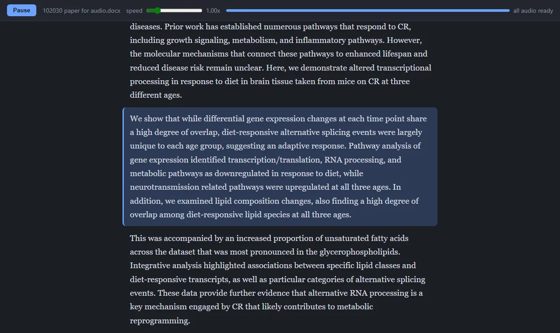
The ReadAlong reader: the paragraph being read aloud is highlighted. -
A self-hosted, AI-searchable notebook for my dissertation sources, since September 2026
- Set up an open-source research notebook (a fork of Open Notebook v1.14.0) that indexes my drafts and references and answers plain-language questions with links back to the sources. It runs on my own hardware, so unpublished work stays on my machine.
- Search works by embeddings: each chunk of a document is stored as a vector that captures its meaning, and a question is matched to the chunks with the closest vectors.
- Out of the box, each search compared the question with every stored vector, about 15 seconds. I added a compressed vector index that pulls the 50 closest candidates and re-scores them exactly: about 2 milliseconds per search. The index repairs itself against the database at startup, rebuilds when I change embedding models, and can be switched off.
- Failed embedding jobs were silently dropping notes from search, and the only built-in fix was to re-embed every note, including all the ones already embedded. I added an option that embeds only the missing records, and a label showing whether each note is searchable.
- Also added a drop-folder inbox, a switch to load or unload each model from GPU memory, a one-click tray launcher, GPU document extraction, and a fix for text that kept some documents from saving. 115 pytest and 62 Pester tests; 43 commits in the first three days, in my local repository.
- Planned next: hybrid keyword and meaning search, a reranker, chunks that follow a paper’s sections, and page-level citations.
Business & consulting
-
Founder & Owner, Tye Handyman Services, Minnesota and North Dakota
- Started with self-taught handyman jobs during summer breaks at 14. By high school it was a 3-person team renovating apartments for commercial clients; I brought in help when client deadlines required it.
- Over 15 years: 40+ clients, all by word of mouth, and $200K+ in lifetime revenue.
- Renovation, carpentry, plumbing, electrical, construction, landscaping, audio/video installation, tech repair, and computer design and assembly.
-
Herbal Aspect, Madison, WI. Research Consultant & Product Developer (2021–2024), then also Assistant Manager & Business Analyst (2024–2026).
- Designed the Hourglass, a 3D-printed retail accessory that grew its category from 3% to 24% of company-wide sales, and from $22K to $185K in annual revenue. It has gone through 8 design versions; I print it for the company, which has reordered since early 2024.
- Built models of customer and market data, predictive models of customer behavior, financial models and projections for budgets and product decisions, and KPIs, in a heavily regulated market.
- The company relied on me to get its data migrations done: I rebuilt records the platforms would not export from the company’s own records, built platform-agnostic recreations in R in each new platform’s required format, and kept the data organized for the next move.
- Educated owners, managers, staff and customers on current medical and scientific research, each at their level, and wrote educational material for customers and business partners.
- As assistant manager, led and motivated staff. Held the top gross sales per hour for 3 years and helped open 6 new stores.
- Badger G, a genetically engineered cannabis strain with no THC and no CBD, developed at UW–Madison: I was the contact with its lead scientist and sat in on negotiations to weigh in. Growing for minor cannabinoids needs different methods from growing for THC, so I researched it on a plant of my own, testing CO₂ supply and other stressors. When the grower’s first batch underwhelmed, I ran A/B tests with the grower on parallel batches of live plants and educated the grower in what worked, which fed the crops that followed.
- Appeared on Channel 3000 news for the company, August 2025.
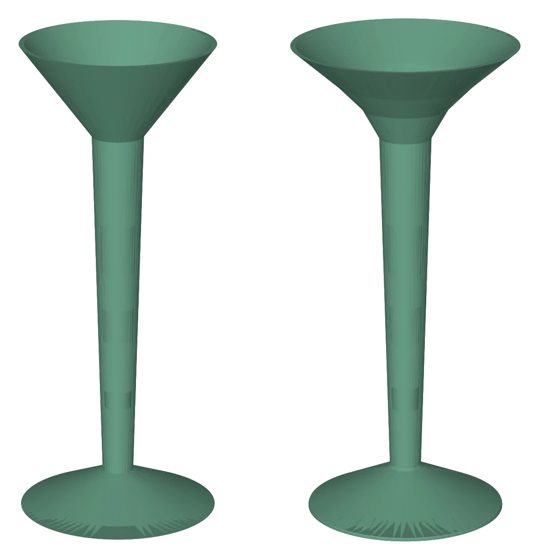
The Hourglass, versions VII and VIII, rendered from my design files. 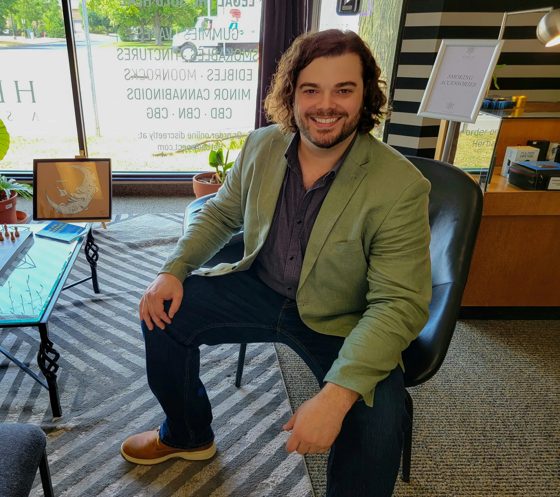
At Herbal Aspect. 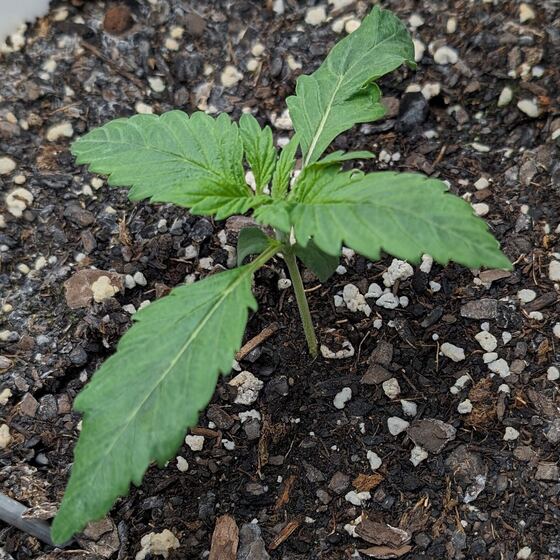
My own Badger G research plant, grown in my apartment. 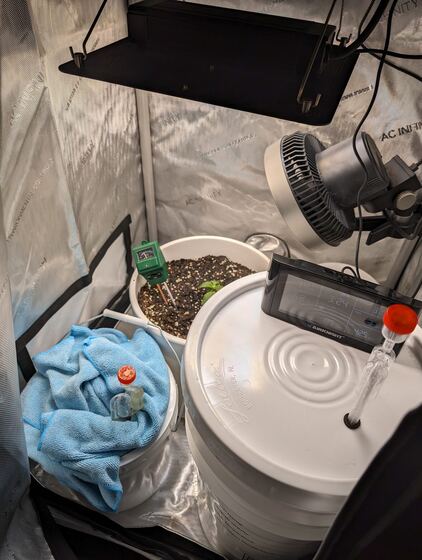
The grow tent in my apartment, with fruit wine fermenting alongside to raise CO₂. 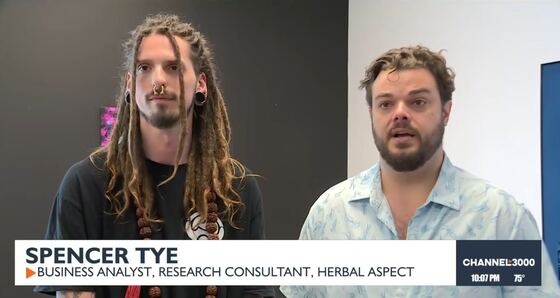
On Channel3000 news for Herbal Aspect, August 6, 2025. Watch on YouTube. -
Project Manager & Consultant, WiSolve Consulting Group, Madison, WI (2022–2026). An independent nonprofit consulting firm staffed by UW–Madison graduate students and postdocs. Each project has a project manager, an advisor and consultants, runs under a statement of work, and lasts 2 to 8 weeks. It gives Madison-area businesses data-driven recommendations and trains its members in consulting. Projects include market analysis, SBIR and STTR grant support, business plans, technology transfer and marketing strategy.
- Project manager on 4 projects for life-science companies. Led 2 consultants across 3 SBIR Phase II market sizings for biotech startups, and ran one of the analyses myself.
- On the fourth, for a medical-imaging company, compiled clinical-trial data from ClinicalTrials.gov and estimated the drug market and the number of MRI scanners in the US, EU and worldwide.
- As project manager I owned the client relationship, set each consultant’s weekly goals, checked every figure against its source, and compiled the final deck.
- Sized markets as total, serviceable available and serviceable obtainable market (TAM, SAM, SOM) from industry market reports, SEC filings and the epidemiology literature, with every figure cited.
- Earlier, as a consultant for a cardiology startup: estimated the costs of heart-attack and heart-failure care, mapped the FDA path from an early advice meeting to an IND submission, traced a competitor’s path, and identified 19 key opinion leaders (cardiologists, regulatory specialists and potential acquirers).
- Client deliverables are under NDA, so they aren’t shown here.
-
Doctoral Minor in Business and Entrepreneurship, composed entirely of MBA coursework (GPA 4.0)
- Covered consulting, organizational change, and data and platform migration strategies.
-
My first formally registered business, formed during graduate school
- Formed mainly so I could take on more charitable and pro bono work without it straining my personal finances.
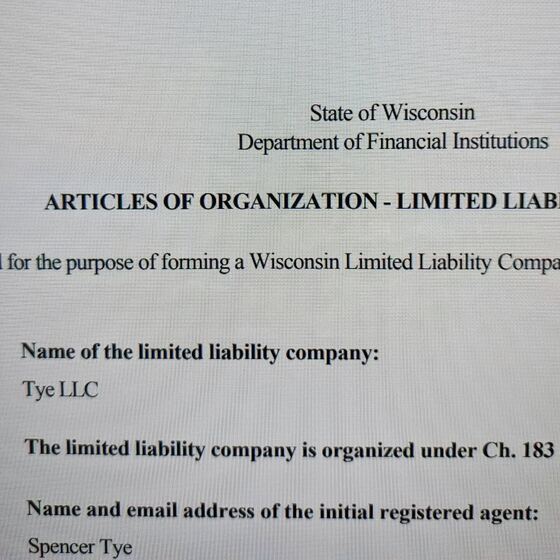
Part of the Articles of Organization, State of Wisconsin Department of Financial Institutions. -
Consultant, Business and Entrepreneurship Clinic, Wisconsin School of Business (February 2025 – February 2026)
- Worked directly with the owners and shareholders of Madison-area small businesses and startups on management, new ventures and growth strategy.
Making & repair
-
- I build the computers I use for computational work, and I built my own 3D printer.
- The home lab grew from there: a rescued microscope, a climate-controlled grow tent, and two PCR machines. I use it for personal-interest research out of my apartment.
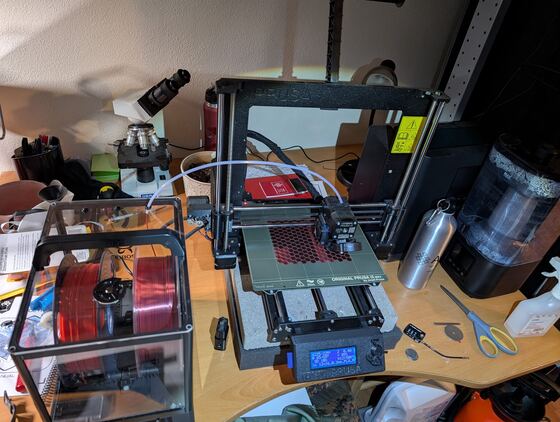
The 3D printer I built. 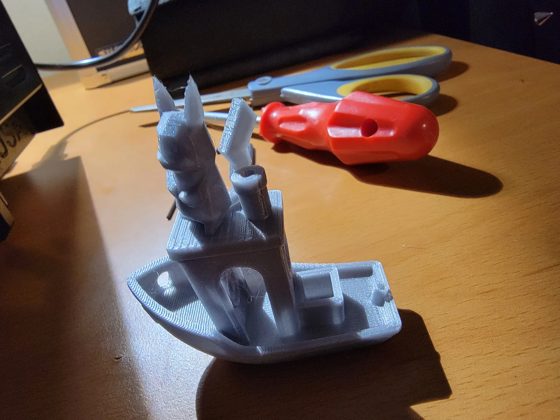
Early prints off the printer. 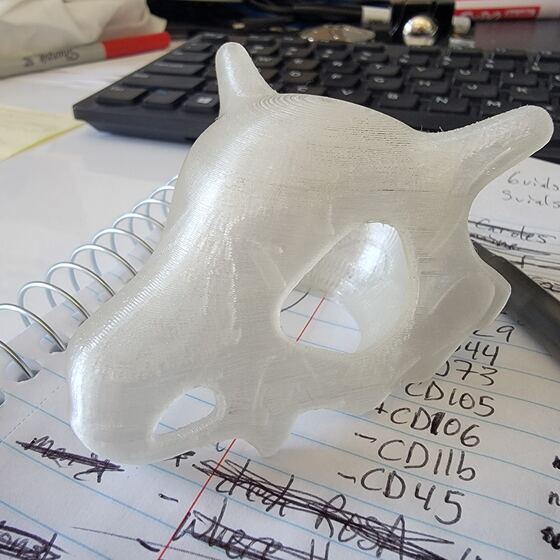
Cubone skull, printed on the 3D printer I built. 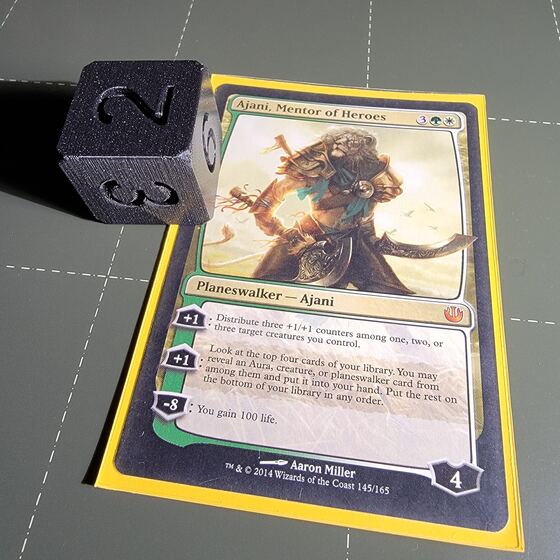
A die from the disability-friendly set I designed: oversized, with deeply cut numbers. Card for scale. -
- Designed and 3D-printed: a multi-part mouse tail restrainer that went through several prototypes before it was used with live animals, and eyepiece adapters that turn any phone into a microscope camera.
- Also: splint rings for Ehlers-Danlos syndrome and a disability-friendly dice set.
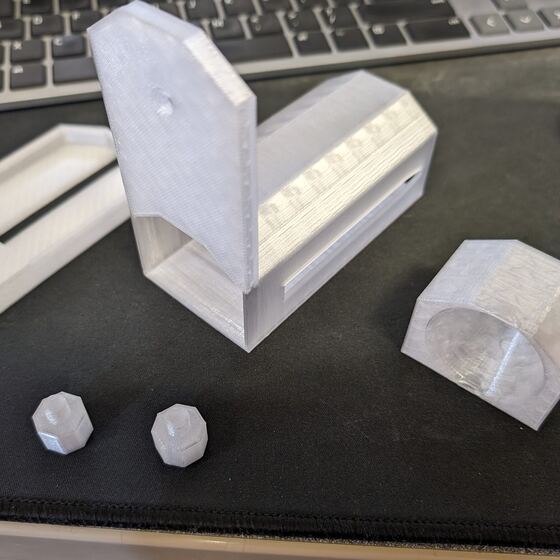
Tail restrainer, printed parts. 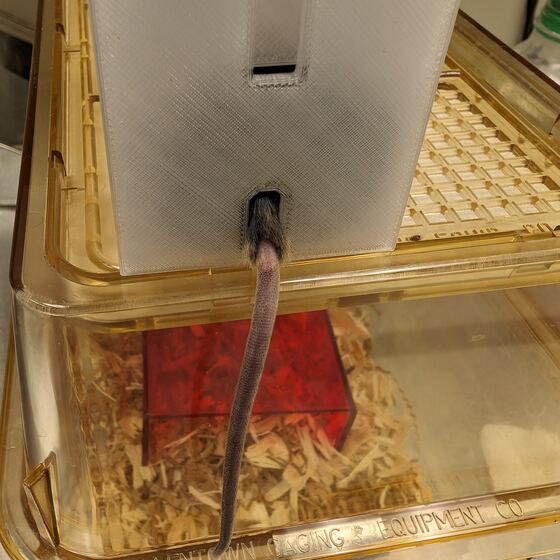
Tail restrainer in use. 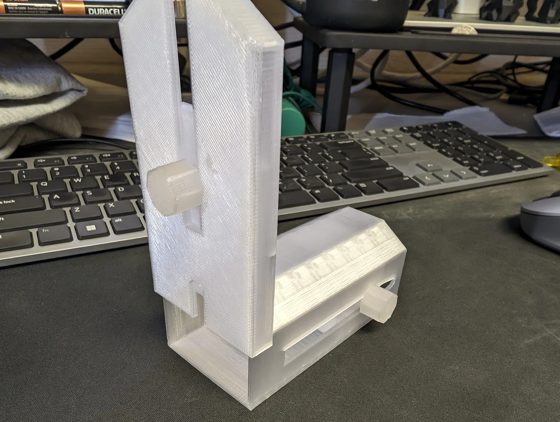
Tail restrainer prototype, assembled. 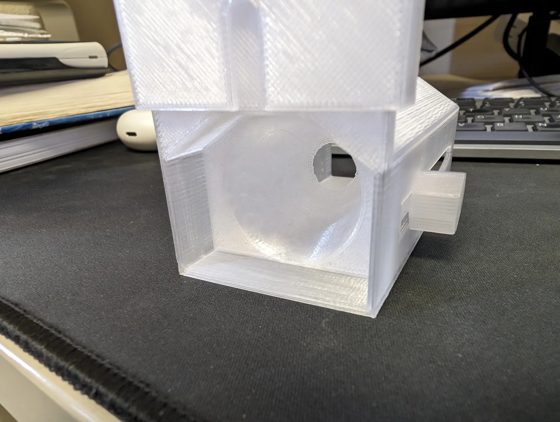
Tail restrainer prototype, detail. 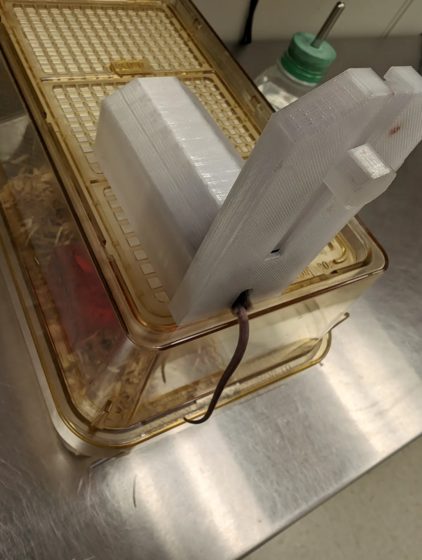
The tail restrainer resting on a standard cage. 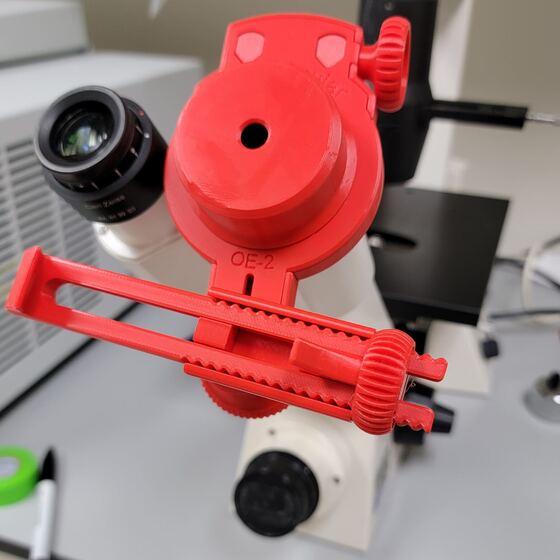
Phone-to-eyepiece adapter, first version. 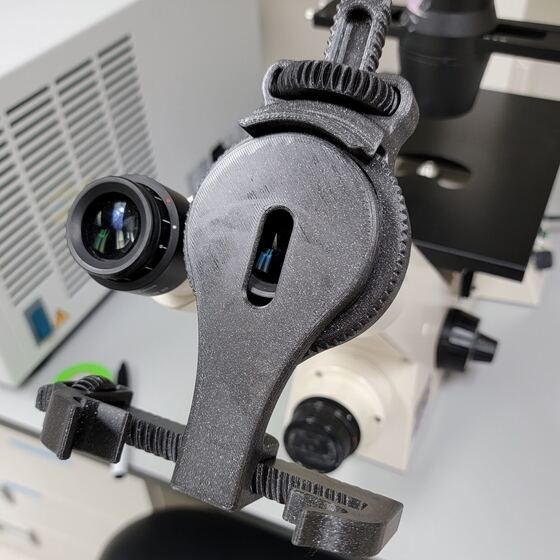
Phone-to-eyepiece adapter, second version. -
- Repaired recycled qPCR machines and microscopes, down to the power supplies, because I wanted those capabilities for projects of my own. I use some of that equipment for personal-interest research out of my apartment.
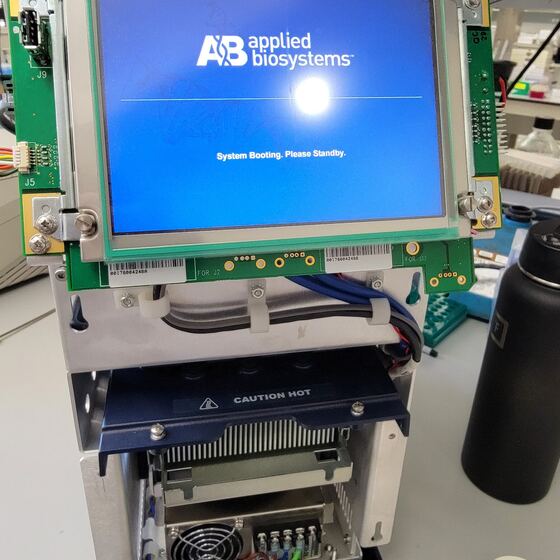
A refurbished Applied Biosystems qPCR machine booting. 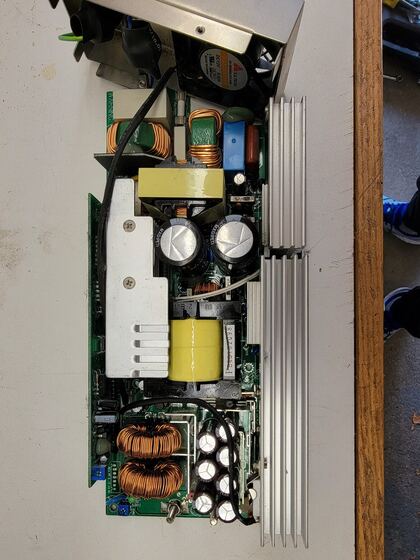
Inside the machine during repair, tracing the power supply. -
An unfinished build for the Midwest Aging Consortium symposium at Mayo Clinic
- Started building an interactive poster so visitors could explore my 3D data visualizations directly. It was not finished in time for the symposium.
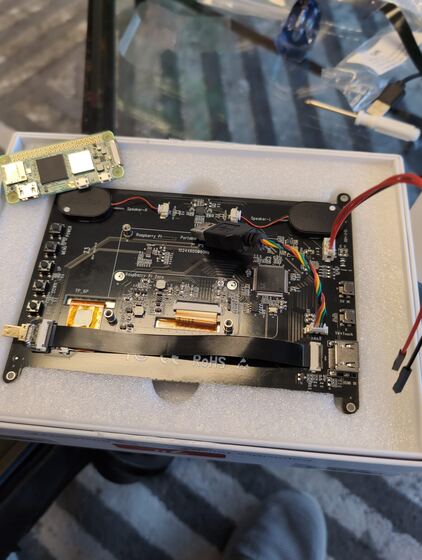
The Raspberry Pi Zero and display board for the interactive poster.
Leadership & service
-
Public Relations Coordinator (elected), North Hennepin Community College Student Senate
- Advocated for students at the college, at the state level through LeadMN, and nationally.
- Part of a team of 8 that lobbied for a state bill securing $142M in additional funding for Minnesota two-year colleges. We also flew to Washington, D.C., to lobby Congress; that work spanned many bills, so the state bill is the clearest single result.
- LeadMN Leadership Scholarship ($1.5K); Phi Theta Kappa Coca-Cola Leaders of Promise Scholarship ($1K).
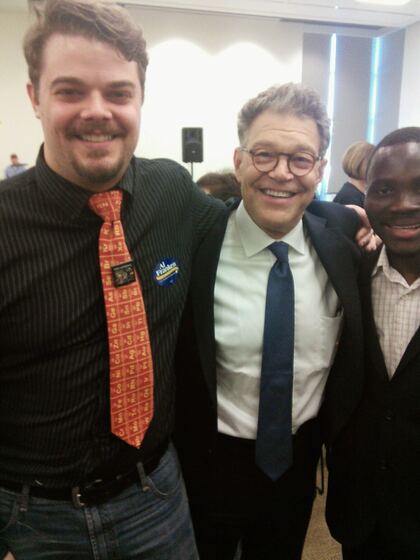
With Senator Al Franken while lobbying as Student Senate PR coordinator, 2014. 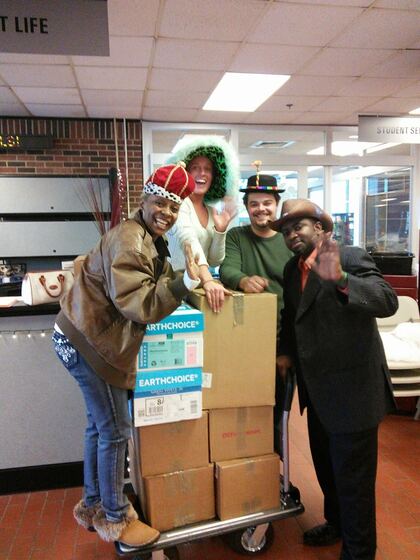
Moving into the Student Senate office while I was PR coordinator, 2014. 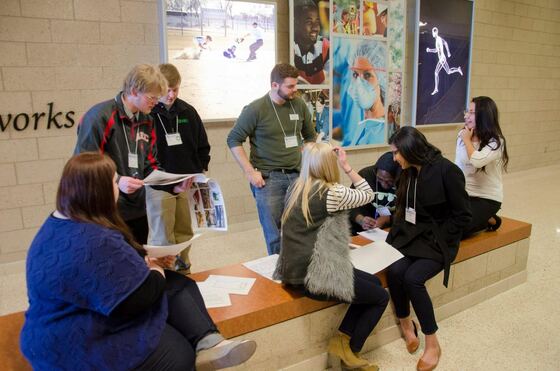
Work with LeadMN as Student Senate PR coordinator. 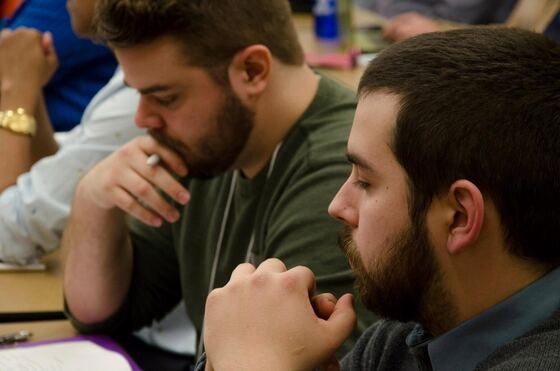
More LeadMN work. 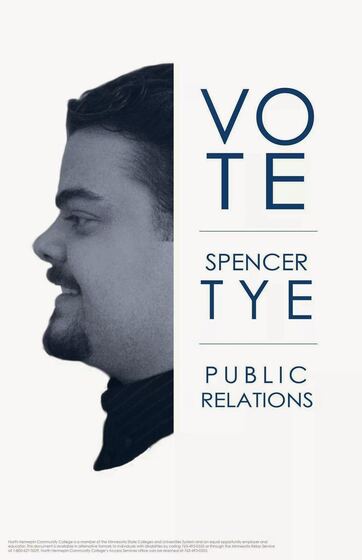
Campaign poster: Vote Spencer Tye, Public Relations. 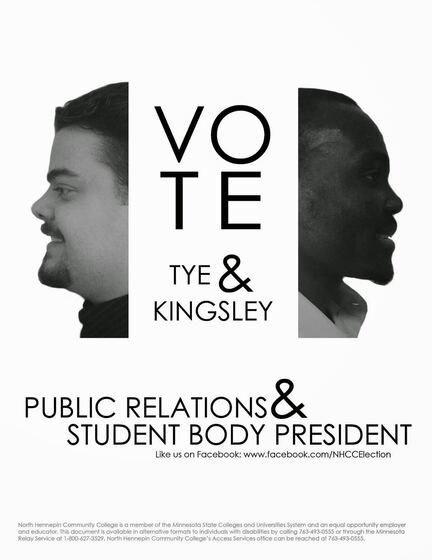
Campaign poster: Vote Tye & Kingsley, Public Relations & Student Body President. -
Ombudsman, North Hennepin Community College Student Senate (2015–2018)
- Named 2016 NHCC Student of the Year (1 of 4,446 students) for a year-long investigation of racial and sex discrimination against students, especially foreign and international students, in the college’s nursing and medical lab technician programs, which shared faculty and one director.
- Tutored nursing students, and passed the entry exam into the medical lab technician program to see it firsthand, keeping near-perfect grades. Interviewed students, compared essay grades to show that grading tracked race and sex, and gathered reports from other faculty going back about 20 years.
- In one case I witnessed, an instructor made an Indian student stand in front of the class repeating a medical term until his accent satisfied her.
- The director said no complaints existed, but those are records the programs must keep and forward for accreditation. I used that violation to bring the evidence to the college administration.
- Over the following summer the college replaced about half the staff of both programs, and the director retired.
- The role also covered investigating maladministration, mediating with administrators, and public speaking.
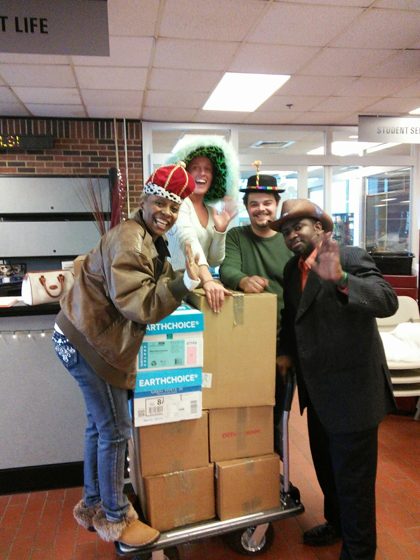
With the NHCC Student Senate. -
Editor in Chief, Northern Light Research Journal, North Hennepin Community College
- Brought the natural sciences and peer review into the journal for the first time, which made it the nation’s first student-run, peer-reviewed research journal at a community college.
- Built the scientific peer-review network and set up partnerships with other departments.
- Hired and trained staff, ran daily operations and biweekly meetings, handled marketing, and fact-checked, edited and peer-reviewed articles.
- Academic Achievement Award in Liberal Arts and Global Education (1 of 4,446 students).

Call for papers from the Northern Light Research Journal. -
- Tutored through undergrad and since, with many organizations.
- Involved with TRIO programs; took part in McNair Scholars panels and workshops during grad school.
- Volunteer medic at protests across the political spectrum, treating anyone who needs help.
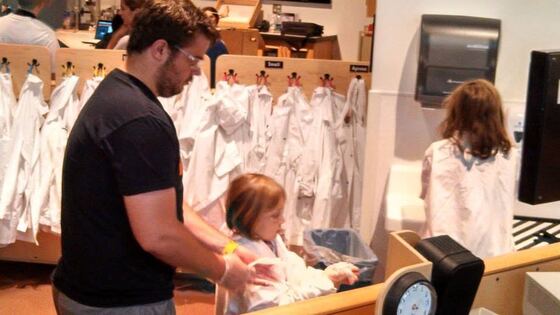
Tutoring children. 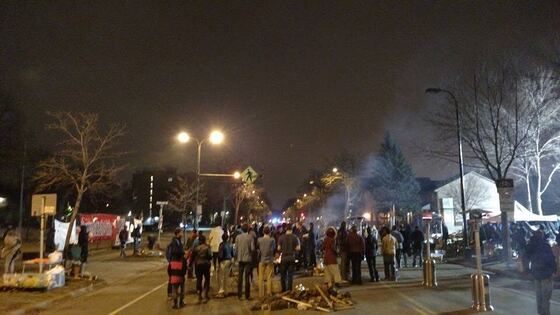
One of the protests where I volunteered as a medic. 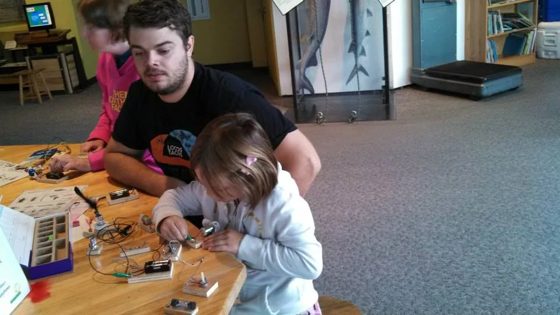
Tutoring kids through a hands-on circuits project.